
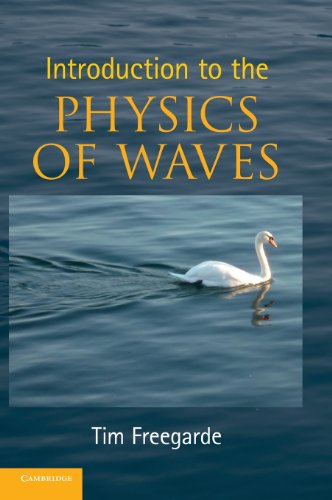
Introduction to the physics of waves / Tim Freegarde, University of Southampton.
Material type: TextPublication details: Cambridge : Cambridge University Press, 2013.Description: xiv, 296 pages : illustrations ; 26 cmContent type:
 - text
- unmediated
- volume
- 9780521197571
- 531/.1133 23
- QC157 .F74 2013
- SCI055000
| Item type | Current library | Call number | Status | Date due | Barcode | |
|---|---|---|---|---|---|---|
| Book | KCST Library | 531.1133 Fr In (Browse shelf(Opens below)) | Available | 1000000609 |
Includes bibliographical references (pages 286-290) and index.
Machine generated contents note: Preface; 1. The essence of wave motion; 2. Wave equations and their solution; 3. Further wave equations; 4. Sinusoidal waveforms; 5. Complex wavefunctions; 6. Huygens wave propagation; 7. Geometrical optics; 8. Interference; 9. Fraunhofer diffraction; 10. Longitudinal waves; 11. Continuity conditions; 12. Boundary conditions; 13. Linearity and superpositions; 14. Fourier series and transforms; 15. Waves in three dimensions; 16. Operators for wave motions; 17. Uncertainty and quantum mechanics; 18. Waves from moving sources; 19. Radiation from moving charges; Appendix: vector mathematics; Index.
"Balancing concise mathematical analysis with the real-world examples and practical applications that inspire students, this textbook provides a clear and approachable introduction to the physics of waves. The author shows through a broad approach how wave phenomena can be observed in a variety of physical situations and explains how their characteristics are linked to specific physical rules, from Maxwell's equations to Newton's laws of motion. Building on the logic and simple physics behind each phenomenon, the book draws on everyday, practical applications of wave phenomena, ranging from electromagnetism to oceanography, helping to engage students and connect core theory with practice. Mathematical derivations are kept brief and textual commentary provides a non-mathematical perspective. Optional sections provide more examples along with higher-level analyses and discussion. This textbook introduces the physics of wave phenomena in a refreshingly approachable way, making it ideal for first- and second-year undergraduate students in the physical sciences"-- Provided by publisher.
"Balancing concise mathematical analysis with the real-world examples and practical applications that inspire students, this textbook provides a clear and approachable introduction to the physics of waves. The author shows through a broad approach how wave phenomena can be observed in a variety of physical situations and explains how their characteristics are linked to specific physical rules, from Maxwell's equations to Newton's laws of motion. Building on the logic and simple physics behind each phenomenon, the book draws on everyday, practical applications of wave phenomena, ranging from electromagnetism to oceanography, helping to engage students and connect core theory with practice. Mathematical derivations are kept brief and textual commentary provides a non-mathematical perspective. Optional sections provide more examples along with higher-level analyses and discussion. This textbook introduces the physics of wave phenomena in a refreshingly approachable way, making it ideal for first and second-year undergraduate students in the physical sciences"-- Provided by publisher.
There are no comments on this title.